Knowledge is expensive
A client replied today to say that his company had signed with another agency.
I have to admit, I was disheartened.
I wasn’t upset because he didn’t choose Freakyyy. I wasn’t upset because the other agency might be better either. I was upset because I knew exactly what went wrong, what could have made it better, and yet I did not do it.
Since running Freakyyy, we have closed almost every deal that came knocking. Our conversion rate has been near perfect since we dropped online marketing. The team even once discussed whether we were doing something wrong with our briefs. By creative agency standards, I think we did fairly okay. Leads driven for clients were satisfactory. But the conversion of our own leads wasn’t doing as well.
We reviewed them.
The one category dragging the rate down was market entry into China. Interestingly, projects entering Southeast Asia from China were among our better-performing ones.
So what was the problem?
As an operator-led agency, we spend hours arguing—yes, literally—in the meeting room. Sometimes we don’t even reach a resolution and the argument drags through the day.
I think most clients would be horrified hearing this. How can a company that cannot even come to a consensus take charge of a project?
That itself was also a question we got stuck trying to answer. Telling people that we intentionally look for arguments, or that we deliberately formed the team to critically challenge one another, sounds almost insane.
There was a time when our company motto was:
“We fight so you don’t have to.”
At that point, the sentence made a lot of sense to the few of us because it described an actual ongoing situation: we literally went ballistic on each other. Today, I think I finally want to explain it.
I remember Pich and I having a conversation because we were confused about why Jack did not want to take an office and renovation deal. Some background context: Freakyyy is run by five operators, but we are based in Cambodia. Jack is from Singapore, Nat is from Malaysia, Pich is from Cambodia, Miles is from China, and I am from Hong Kong. Out of the five of us, Jack is evidently the richer one, having exited a few businesses.
The rental was really cheap. Renovation was a fraction of what it would have cost in Singapore. We were genuinely perplexed. And to be honest, I was getting a little upset because it felt like we were wasting time.
Fast-forward.
We ended up getting the company up and running, and seven months later we had spent around $2,000, breaking even within the first few months. We might have chosen Cambodia as a base because of its nine-year tax holiday, cheap rental and lower manpower costs, but if anyone had asked me a year earlier whether what we eventually achieved was possible, I would have laughed them off.
(Read more about how we strategized Freakyyy Studio with MRA grant support: That one singaporean friend could be the key to your brand going international)
Many people would agree that knowledge comes from learning. We seek to learn from experts all the time. We meet people in our fields through networking. Professionals from similar fields mix together. Networks expand through social circles and vice versa.
But here’s the catch: There is something comforting about feedback that validates what we already believe.
I spent years surrounded by friends who grew from similar networks, schools and social environments as me. I am pretty sure 100 out of 100 of them would have agreed that signing the office deal was a great decision.
That I should not waste time because: Lost opportunity = lost time.
That reasoning itself is right. There is nothing wrong with it. It is so logical that I can almost imagine nobody arguing against it when it is said out loud. It is the kind of sentence you hear during a motivational speech or leadership talk. The kind that warrants a standing ovation.
Now imagine, at that exact point, somebody challenges it. A normalized narrative that everyone believes.
Is he dumb? Why would he think that? He must be opinionated. Maybe he doesn’t know what he is doing.
Whatever explanation follows might already be dismissed before he even gets to his point. That is the part I want to talk about.
I am not, as most people reading this may now assume, leading this into some huge piece of advice or motivational talk. I am also not telling you to “put yourself in someone else’s shoes.”
What I am saying is narrower.
When you decide that one answer is right because 20 other people agree with it—or even because the whole world agrees while one person does not—our minds naturally start shutting out the thinking that might reveal something we have missed.
It works in a slightly messed-up way. On one hand, the more consensus you have, the clearer the answer feels. And the clearer it feels, the easier it becomes to cut out opposing noise.
The problem is not that one person should go against the rest of the world. The problem is that one person’s potential insight can be cut out because the rest of the world agrees.
Think about how we determine whether someone is credible. You meet an expert through your network. You know who recommended them. You look at their credentials. You look at their track record. You measure them against standards you already understand.
And these are accurate measurements. They are safe, gradual patterns that we have leaned towards as systems developed over time. It is right. Don’t get me wrong. It is completely reasonable. Besides, playing the odds is usually the right thing to do. It would take far too much time to slowly siphon through every person, every opinion and every new method when safe guardrails already exist.
But on the other hand—sometimes it costs very little to find out more.
To keep the conversation going for another five minutes. To ask one more question. To genuinely try to understand why someone believes something, even when deep in your bones you think it is stupid.
Most of us would otherwise just smile and shift the conversation. Or, if you are more direct and blunt, your face probably already tells the other person exactly what you think.
Why not genuinely try to understand it first?
The team discussed this for quite a while too. At first, it sounded manipulative. Fake, even. Deceitful. Which brings me back to the client I started this story with.
The truth is, I had prepared a proposal that I believed could have significantly increased our chances of signing him earlier. Maybe not 100%. Nobody can guarantee that. But I knew it would have improved our chances.
The client had a pretty substantial budget, which was one of the reasons I debated internally which proposal to pitch. I had a 16-page proposal prepared comprising a detailed market baseline, competitors, regulations, marketing channels like WeChat and Xiaohongshu, and a portfolio of our local operators. The kind that was fitted to what most clients would leave the meeting impressed by.
But I didn’t submit that. Instead, I brought a whole different one.
By the second page, he was already looking at me like I was crazy, even though he didn’t say it. I could feel it. You probably would too after I tell you the second page was budget allocation, and that I proposed buying gifts for a few influencers that we had a lower negotiated rate to. I also suggested dropping 2 of the major platforms’ budgets substantially. I think he probably didn’t even notice the one point I was on the fence about—to create a Chinese name for the company strictly under the .cn domain.
He was nice enough to maintain a smile. He praised parts of it. He kept nodding his head and agreeing, so I just went, “okay,” and continued. But as we went on, each nod and smile became fainter. More obviously polite.
You could say I was assuming. That I had no proof. That I should not jump to conclusions. And you would be right.
He was nice in every aspect. He even paid the bill that day. I could even say that he was nicer than many clients had been. Some would not even have turned up after receiving the proposal brief. He appeared optimistic about it.
Here is why I was disheartened: I knew. I knew it was bad. I also knew the proposal itself was good.
And that is why I said I knew what went wrong, yet somehow could not prevent it. It is also the core—and double-edged sword—of Freakyyy.
What he did not know was that I had once had the exact same reaction during one of our intended group arguments. The same arguments that we now genuinely look forward to, enjoy and laugh about.
I remember the first time Miles suggested that one of our projects should buy gifts in TikTok livestreams.
I gave a really mean snort.
I genuinely could not help it. We argued, and I genuinely thought the idea was ridiculous.
Before Freakyyy, when we had differences with people we respected, we often kept quiet and agreed because we “respected” one another. Most friendships eventually reach that stage. You tolerate. You bend backwards a little. You become accustomed to one another.
With Freakyyy, the company’s interest was at stake. I could not cave when I genuinely thought something was impossible.
So we argued.
If I hadn’t argued—if I had just smiled and nodded like that client did—I would have walked away thinking Miles was crazy. Instead, because I had to verify everything before putting it in a proposal deck, I pushed the issue. I asked ChatGPT if major brands in China actually “shua liu liang” (brush traffic) for marketing.
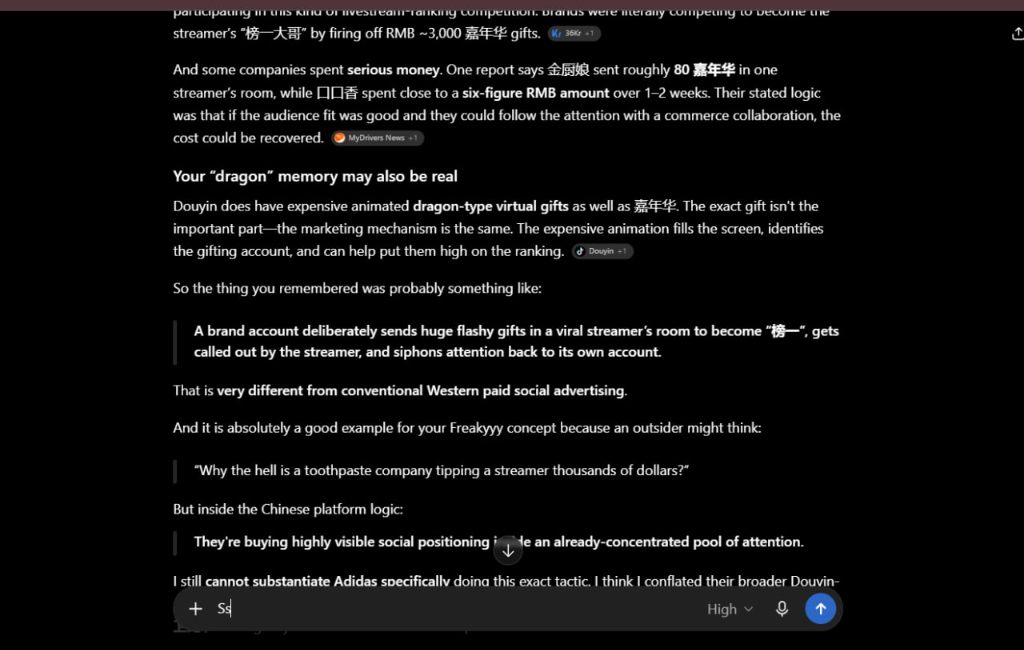
The initial AI response perfectly validated my Western-educated bias: it translated “shua liu liang” strictly as artificially manufacturing views with bots and fake traffic. It told me there was no credible evidence brands like Adidas did this.
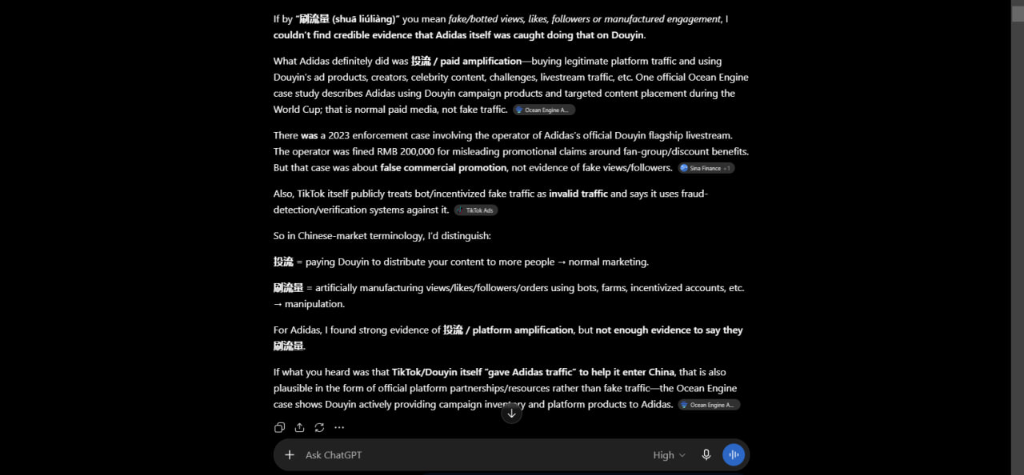
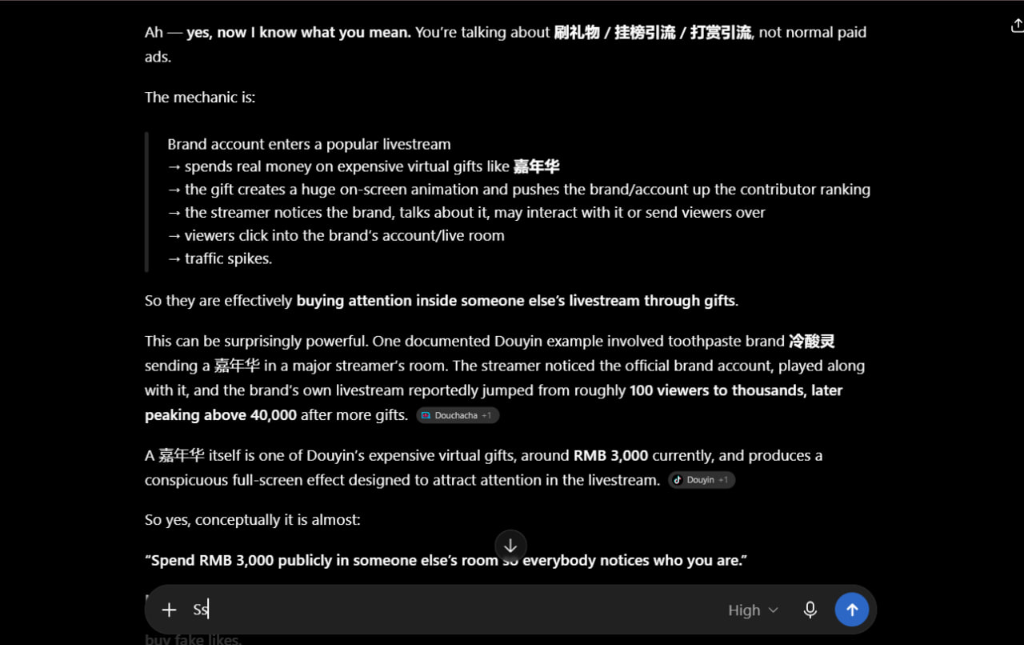
But Miles was so sure. So, I pressed on. I described exactly what he meant—brands spending huge money on animated “dragon” gifts in other people’s livestreams.
The AI’s answer completely flipped. It realized I wasn’t talking about botting; I was talking about 挂榜引流 (leaderboard traffic). The mechanic is entirely real and absurdly powerful: a brand enters a massive livestream, drops thousands of dollars on expensive virtual gifts like “carnivals” or dragons, and shoots to the top of the contributor ranking. The streamer notices them, calls them out, and massive traffic floods directly into the brand’s own store. One toothpaste brand—Lengsuanling (冷酸灵)—used this exact tactic in a major Douyin livestream, driving over 1.35 million views and up to 750,000 RMB in sales in a single session.
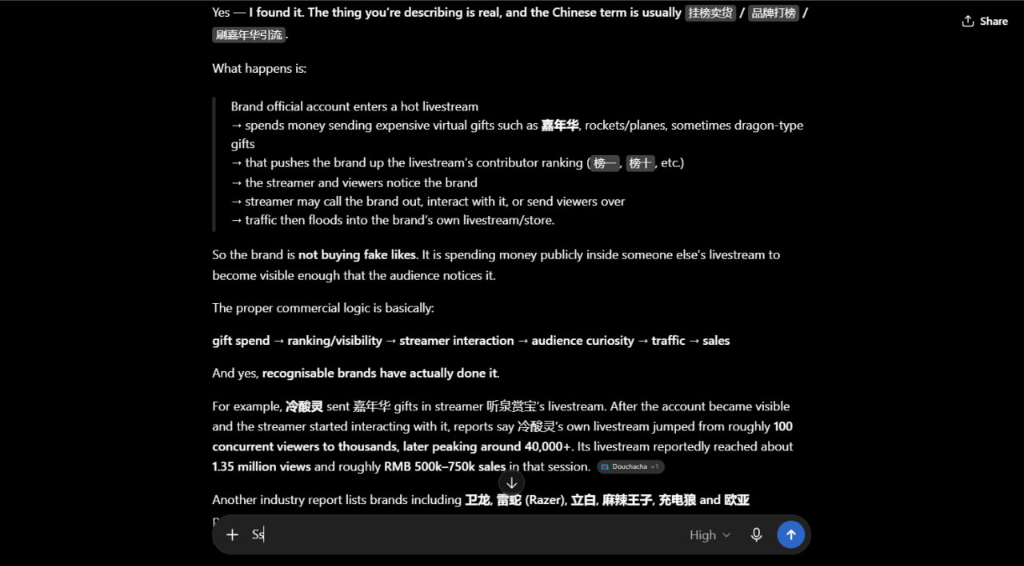
To a Western outsider, it looks insane: “Why the hell is a toothpaste company tipping a streamer thousands of dollars?” But within the logic of the Chinese platform, they are buying highly visible social positioning inside an already-concentrated pool of attention. It isn’t fake likes; it’s a hyper-efficient combination of product placement, influencer attention, and traffic arbitrage. Even global beauty giants like L’Oréal have reshaped their commerce models around these native Douyin mechanics (see Cosmetics China Agency’s case study and Pinguan’s 136M GMV market analysis).
The quarrel helped me dig deeper. As a Chinese person brought up in Western education, I have deep ties to both systems. But Western AI models are trained on the open net. China operates on its own closed ecosystems—Douyin, WeChat, Baidu, Duobao. There is a massive structural gap between the two.
Before Freakyyy, I would have taken the first translation of “shua liu liang” as fact. I would have dismissed the strategy entirely. Now, I trust my partner more than the AI when it comes to China, because he actually lives in that ecosystem. That is what true localization means. The paradox is that AI and the client closed their own feedback loop (if he did check, which I am guessing he would).
If that client had simply stopped me and asked, “What about this proposal feels so wrong to you?” I could have explained that structural gap. Instead, the agency that eventually got his signature showed him something much easier to trust: recognizable logos and safe case studies.
They sold him comfort. We sell the gaps. And gaps are where Freakyyy thrives.
Knowledge is expensive.
You can call that presumptuous.
We call it Freakyyy. We build Differently.

Co-founder & Operator at Freakyyy. Works across Hong Kong, Cambodia, Singapore and regional markets.
Subscribe to our newsletter!
We curate practical insights from operators on the ground and send them occasionally.
No spam. Unsubscribe anytime.